Net Zero Programme: Looking beyond carbon emissions
The Net Zero Programme was established to focus on the Government’s drive towards a carbon neutral society. Here's a look at its progress.
The Climate Change Act 2008 is the UK’s approach to reducing emissions and preparing for climate change. It set a statutory target to reduce UK Greenhouse Gas (GHG) Emissions by at least 80 percent (against 1990 levels) by 2050. Then in June 2019, secondary legislation was passed that extended that target to “at least 100 percent”. Simply put, if this audacious target is met it will mean the UK will stop contributing to global emissions by 2050.
The property industry has a huge role to play in reducing carbon emissions: according to the UK Green Building Council, the UK built environment (buildings and infrastructure) is responsible for 25 percent of UK greenhouse gas emissions. And a recent United Nations report shows that the global building and construction industry contributes 34 percent of total global energy-related CO2 emissions.
Leading the Government’s drive towards emissions reduction is the Government Property Agency (GPA) – the public sector property holding company responsible for delivering the Government’s property agenda across its office and warehouse portfolios. The GPA currently manages over 950,000 square metres of office estate across the UK. Its vision is a transformed, shared, sustainable and value-for-money government estate. To achieve this the GPA is rationalising, refurbishing and retrofitting the existing estate, as well as constructing modern, sustainable, digitally-connected and inclusive Government Hubs. Here you can see a summary of the most recent financial year’s activities and major program achievements.
Crucially, the GPA is aiming to go beyond just reducing carbon emissions. It’s also minimising consumption of energy, water and waste, improving resilience to climate change (temperature change, flood risk etc.) and reducing carbon embodied in construction.
In late 2020, the GPA established a Net Zero Programme which is being delivered in strategic partnership with Atkins/Faithful+Gould.

The Net Zero Programme
The Programme exists to:
Reduce Consumption
Improve energy efficiency
Decarbonise
Increase the use of green energy
Generate
Locally generate and store green energy
Reduce embodied carbon
Limit emissions during construction
Delivering Significant Carbon Savings
In late 2020, the GPA established its Net Zero Programme. The programme demonstrated immediate impact, achieving carbon savings in its first year, equivalent to more than 2,000 flights from London to New York, or planting circa 47,000 trees.
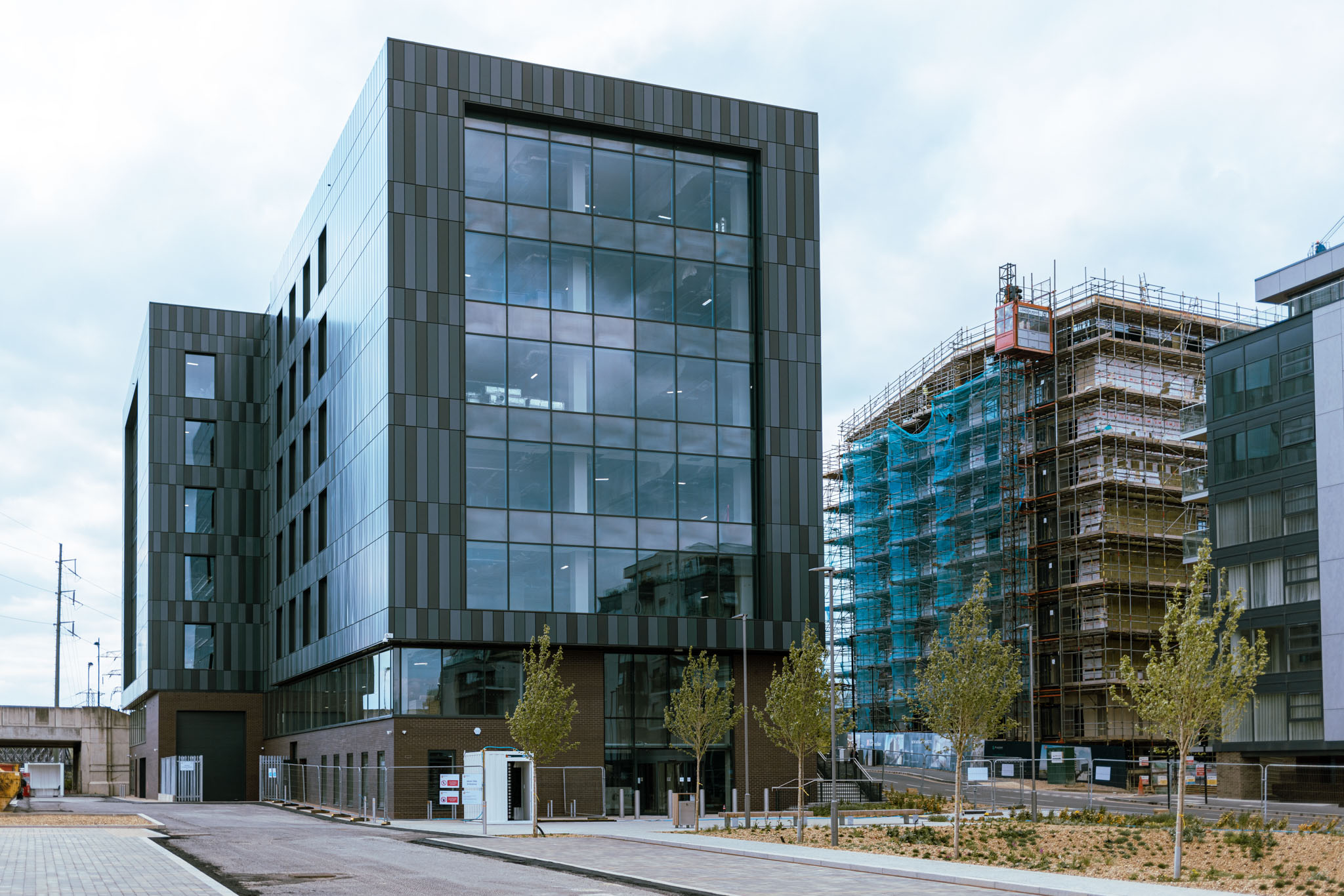
And today, this foundational work continues to drive significant efficiencies across the GPA portfolio. Net Zero and sustainability initiatives are being designed into spaces as early as possible, starting from construction design, where facilities like the Croydon Hub new build is designed to exceed BREEAM Excellent standards and is generating solar gain through building facades.
Energy efficiency is also being delivered through major retrofitting projects: in Titchfield, energy usage from lighting has been reduced by a forecasted 75 percent by replacing circa 2,000 aged luminaries with modern LED products. This also returned significant maintenance cost savings, and saw 100 percent of the packaging from the upgrade works returned to the supplier to reuse for the next supply of lighting.
Similarly, replacing ageing external car park and access lighting in Coventry is returning an estimated 60 percent energy saving.
Facades at Ruskin Square, Croydon generating solar gain.
Optimising building operations
Lagging was installed to more than 2,000 metres of pipework on the Whitehall boiler system in London. This, along with new plate heat exchanges, will achieve greater than 17 percent carbon reduction, with an expected 91 percent carbon reduction when the project is completed.
An obsolete Building Management System was replaced in Nottingham with a modern system that is allowing more efficient building control strategies. This is creating a more comfortable environment for building users, as well as offering greater insights into how the building can be better managed to maximise efficiencies.
Looking forward to a sustainable future
The Government has mandated a 78 percent reduction in carbon emissions across the public sector by 2035 (against a 2017 baseline). Leading by example in making buildings Net Zero and sustainable, the GPA is actively working to reach this same 78 percent reduction for its managed office estate by 2032, three years ahead of the government’s target.
The property industry as a whole faces many unique challenges in the journey to Net Zero. By looking beyond carbon emissions, it’s clear there are opportunities to take great strides in achieving a carbon neutral society.