
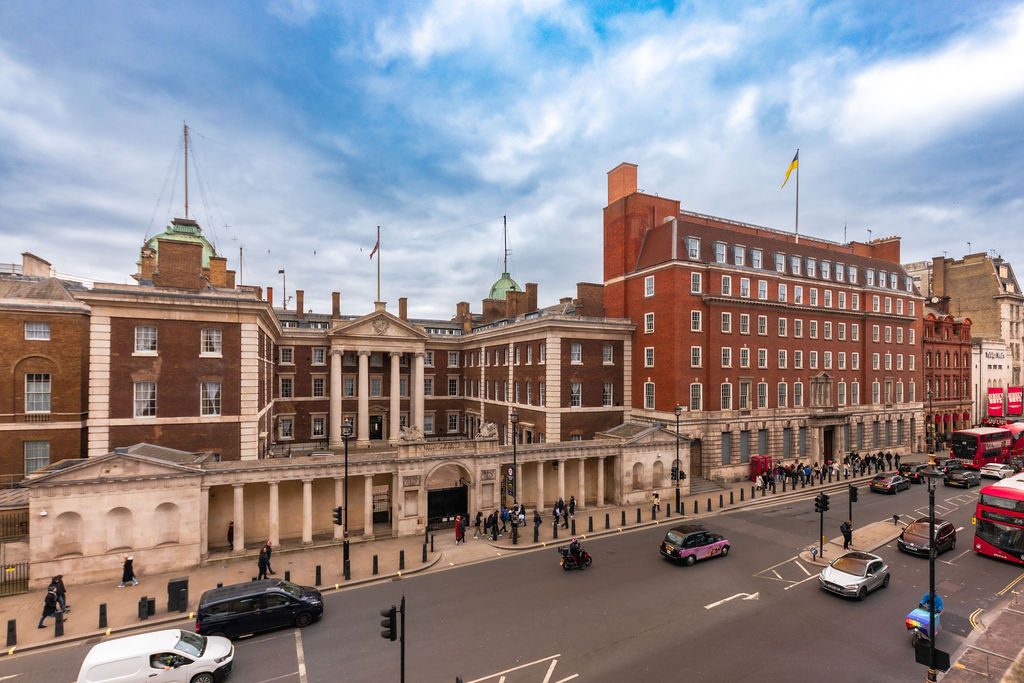
Historic office space secures accolade
Earlier this month, 22-26 Whitehall, a Government Hub managed by the GPA, received ‘Inclusive Environments Recognition’ from the Construction Industry Council (CIC) as it was commended for its accessibility.
A Civil Service building in the centre of London has received a prestigious award, marking a key achievement for the Government Property Agency (GPA).
Earlier this month, 22-26 Whitehall, a Government Hub managed by the GPA, received ‘Inclusive Environments Recognition’ from the Construction Industry Council (CIC) as it was commended for its accessibility.
Comprising the Grade I listed Ripley Building and Kirkland Building, 22-26 Whitehall serves as the London headquarters for the Department for Science, Innovation and Technology (DSIT) and is part of the wider Westminster Campus.
Sam Carey-Smith, Head of Workplace Design at the GPA, said:
“This is an unprecedented achievement for the GPA, as we have secured this accolade for a listed building for the very first time. The accreditation from the CIC not only underlines our mission to create great places to work for civil servants but also our commitment to a high-quality and accessible design in our buildings. Inclusive offices remove barriers that may prevent individuals with physical, cognitive and sensory needs from fully participating in the workplace, so it is paramount that we continue to build on this recognition and create a level playing field throughout the government office estate.”
In July 2025, the GPA finished a major refurbishment at the Government Hub where the agency upgraded a number of features that ensured DSIT is now provided with a workspace that accommodates the needs of all of its staff members.
The CIC recognition reaffirms the GPA’s mission to design workplaces that go beyond minimum legislative standards, creating a truly inclusive and accessible space where everyone feels welcome and accepted.
Eoin Burns, CIC Inclusive Environments Review Group Member, said:
“Inclusivity was clearly embedded at the heart of the relocation process. The approach taken by the Government Property Agency placed staff engagement at the centre of decision-making, ensuring that inclusive design was not an afterthought but a guiding principle throughout. What is especially noteworthy is how inclusive design was successfully prioritised within the constraints of a Grade I listed building. Refurbishment projects of this nature are inherently complex, and embedding inclusive design principles adds an additional layer of challenge. However, in this case, those challenges have been met with a thoughtful and well-executed response, resulting in a building that is both sensitive to its heritage and highly functional for all users.”

As part of the redevelopment works, power-assisted doors and step-free access were implemented throughout the office space, while the main circulation routes have been designed to be generous and unobstructive, ensuring staff with mobility issues can move easily between different areas of the building.
Accessible showers and changing rooms were also added, alongside universal and single-sex toilets, while each floor also features a refreshment hub with sensor-operated taps, improving usability for people with mobility impairments.
Height-adjustable desks are provided to support varied working postures and mobility requirements, while ‘do not disturb’ areas feature dedicated furniture settings and dimmable lighting to support neurodivergent users and those requiring focused, private working environments.
The wayfinding strategy, based on the GPA standard which was developed with direct input from the Royal National Institute of Blind People (RNIB), incorporates braille, tactile letterings, high-contrast colour schemes, clear sans-serif fonts, and universal symbols. Biophilic design is also embedded throughout the space, aimed at improving air quality, reducing stress and boosting creativity.
The Ripley Building is considered one of the first purpose-built office buildings in the UK, with its construction completed in 1726. It is historically associated with the country’s naval service having been created as offices and apartments for the Lords of the Admiralty.